Wednesday, September 27, 2006

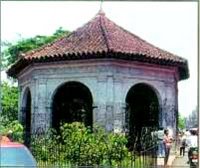
San Isidro Labrador Church and Convent


Reputed to be the biggest and among the oldest in the country, it has been declared a historical landmark by the Philippine Historical Commision.
The San Isidro Labrador Church and Convent are two separate 19th century structures that stand on two separate lots on an elevated part of Lazi town of Siquijor province.

Seven municipal roads and several century-old acacia trees surround these prominent wood and masonry structures.

The Lazi Church which measures almost 85 meters in length is laid out in a cruciform plan oriented in an east-west direction, with the west end and its transept and apse on the east end. A baptistry and a three-tiered octagonal belltower adjoins the north wall.


The belltower is accessible through the choir loft. The church is mainly a masonry structure with indications of wattle-and-daub construction (the tabique), and sack masonry construction using rubble stone fillings and square-cut coral stone masonry facings joined by lime mortars.

There are indications of wall-embedded round timber posts suggestive of the timber framework. The roof is made of corrugated galvanized iron with gables made of vertical wood boards all on timber framework.


The Lazi Convent, measuring 42 meters by 38 meters, is laid out in an L-shape. The two-storey convent has its lower part made of square-cut coral stone masonry, and its upper part of wood. The steep hipped roof is made of corrugated galvanized iron on timber framework.

Traces of previous alterations exist and are discernable. In some parts of the church walls were interventions made using reinforced concrete, cracks filled up and architectural surfaces replastered with cement. The alterations were associated with the repairs made through the decades ( 1930’s, 1950’s, and the 1980’s).

Also, through the years new structures and services were integrated to serve the new requirements of the occupants. The new additions were the toilets and candle-offering area in the church; and the toilets, a pre-school building and a playground within the convent premises. (Siquijor Heritage Foundation)

Bird Sanctuary and Mangrove Park

Commune with birds and other wildlife at the protected mangrove forest that is the Bird Sanctuary and Mangrove Park.

It is a 400-hectare forest which is a natural habitat and nesting place of birds and other wildlife.

The park is located in Bais City, Negros Oriental.

It is accessible by boat and then a walking distance through a 5,968 bamboo-split boardwalk.

Tuesday, September 26, 2006

Museo it Akean

The Museum of Akean (Aklan) located at Martelino St., Kalibo, Aklan is housed in the "Eskuylahan it Hari" or School of the King.

This one story structure of mortar is designed along neoclassical lines with its arched openings and the straight lines of what is fundamentally a large box.

The school building is one of a number dating from the Spanish era, when public education was first introduced in the 19th century. The museum houses artifacts reflecting Aklan's history and legacy.

The Museo It Akean is the century old edifice which houses the old glory and legacy of the old civilization of the Minuro It Akean- one of the first provinces in pre-Hispanic Philippines.

The "Eskuylahan It Hari" or "School of the King" is where the young Aklanons were forced to learn Spanish during Spanish era and English from the American era. The school is believed to be as old as Kalibo Cathedral as they exhibit the same architectural style.

Central Azucarera de La Carlota

Negros Occidental is known among locomotive enthusiasts as the “Steam Paradise of the Philippines.” The Central Azucarera de La Carlota sugar central in La Carlota maintain these machines in good working condition.

Each milling season, one may occasionally encounter one of these “dragons” creeping along the canefields like a mechanical caterpillar dragging along a host of canefield cars.

Founded over 85 years ago, Central Azucarera de La Carlota, Inc. (CACI) remains at the forefront of the sugar industry. It continues to be a key player in a fast evolving industry fueling the national economy.

Central Azucarera de La Carlota, Inc. traces its history to 1916 when it was estrablished by the Elizalde and Ynchausti families at Hacienda Esperanza in La Carlota, Negros Occidental at the south base of Mt. Kanlaon.

Prior to its establishment, there were already two sugar mills operating in the vicinity : Sta. Teresita and Kanlaon Mills. In 1920, CACI absorbed Sta. Teresita and Kanlaon and began its operations for crop year 1920-21.

Starting with two crushers and nine rolls, CACI expanded in 1925 to three mills. After WWII, it added another three mills in line with its philosophy of growth.

Expansion and modernization continued in the 70's with the installation of the Farrel Mill which increased milling capacity to about 10,000 tons cane per day, enabling CAC to become one of the biggest raw sugar mills in the Far East.

In 1995, Central Azucarera Don Pedro (CADP) under the Roxas Group took over the management of CACI, with substantial investments spent to rehabilitate and improve the mills, boilers, process house and other facilities. CADP is a leading sugar manufacturere with integrated manufacturing operations in Nasugbo, Batangas.

The improvements included the installation of shredder to increase capacity and sugar extraction, continuous vaccum pan, continuous vertical crystallizer and centrifugal equipment to improve boiling house recovery and the upgrading of laboratory facilities to enchance accuracy of sugar analysis and accounting and pollution control facilities.

The initiative resulted in higher milling efficiency and manufacturing recoveries which eventually led to the all-time high production of almost 3.4 milling Lkg bags in Crop Year 2002-2003. As a forward-looking and socially responsible corporation, CACI is gearing for the future with renewed commitment and hope.

CACI is part of and a 100 percent owned coporation of the CADP Group Corporation, a publicly listed sugar investment and management company.

CADP Group was a merget of leaders in the sugar industry - Central Azucarera Don Pedro (CADP) and the former Central Azucarera de La Carlota. The holding company was formed as a result of the corporate reorganization of its parent company, Roxas Holdings, Inc., which aimed to consolidate all the sugar business under the Roxas group.

CADPGC also owns the Central Azucarera Don Pedro Inc., integrated milling and refinery complex situated in Nasugbu, Batangas which is the country's second largest sugar refiner. IT is also a substantial partner in a joint venture that acquired Hawaiian Philippines Company, a sugar miller located also in Negros Occidental.

It serves food and beverage manufacturers that product soft drinks, beverages, powdered juice drinks, milk and infant formula products and other processed consumer food. (Central Azucarera de La Carlota)

Sunday, September 24, 2006

Davao Crocodile Park

The park started from the fascination of the owner, Mr. Philip Dizon, to Saltwater and Freshwater Crocodiles.

He did not think of it as a lucrative business until he learned that crocodiles are raised in United States not just for public viewing but as well as for production of leather purposes.

It was in November 1995 when the government has given the owner the accreditation and permit to operate the 1st Davao Crocodile Park.

Ten years later , on August 18, 2006, the world-class Davao Crocodile Park was opened with the help of the consultant Dr. Gilbert Buenviaje.

The Davao Crocodile Park is an establishment that showcases a ‘state of the art’ crocodile farming system in the Philippines.

It has the most recent crocodile farm design equipped with modern facilities and equipments.

The presence of other exotic animal species like raptors, monkeys, bearcats, snakes, birds, and other reptiles makes it one of the most desired tourist destinations in Davao.

The purposes of this establishment are as follows:
1. tourism
2. public viewing and entertainment
3. venue for educational tours
4. promotion of public awareness through regular lectures
5. conservation of crocodiles and other wildlife animals and
6. acts as a field laboratory for students in Biology, Zoology, Animal Science, Veterinary Medicine as well as for wildlife animal enthusiasts.

The Davao Crocodile Park is at the Riverfront Development in Maa, Davao City. (davaocrocodilepark)

Saturday, September 23, 2006

Pearl Farm Resort

The 11-hectare Pearl Farm Resort was once, literally, a pearl farm, where thousands of white-lipped oysters, transported from the Sulu Sea, were cultivated for their pink, white, and gold pearls.

The resort lies in a secluded island off the coast of Davao City. It boasts Samal Houses patterned after the stilt houses of seafaring Samal tribes of the Sulu archipelago, with schools of tiny fish frolicking between the sturdy poles that support the houses.

All 73 Deluxe rooms, suites and cottages are set on stilts above the tropical blue water or perched on a hillside over looking the sea.

The resort is even able to offer even more luxurious villas in the utmost privacy, which are located on the nearby exclusive island of Malipano.

Guest facilities include airport and boat transfers, baby sitting, hairdryers, medical service, safe deposit boxes, postage, massage, manicure, room service, cable TV, email access, telephone and telefax.

Ample opportunities are available for delightful open-air dining on South-East Asian and Western cuisine at the Maranao restaurant, and guests can also enjoy serene evenings with cocktails at the Parola Bar.

Extensive water sports include windsurfing, speed-boating, scuba diving, water-skiing, hobbiecat sailing, water-cycling and rowing, as well as organised island-hopping tours.

Alternatively you can sunbathe at two outdoor swimming pools, relax in the Jacuzzi, on the two tennis courts or in the fully equipped games room. (wowphilippines)

Magellan's Cross


The large cross was planted in Cebu by Portuguese and Spanish explorers as ordered by Ferdinand Magellan in 1521. This is to celebrate the baptism into the Roman Catholic religion of island chief Rajah Humabon, his wife, and some 500 of their followers.

This cross is housed in a small chapel next to the Basilica Minore del Santo Nino on Magallanes Street, just in front of the city hall of Cebu City. The street is named after Magellan, Magallanes being the Spanish translation of the Portuguese explorer’s name.

A sign outside claims that the original cross is encased in the tindalo wood cross displayed in the center of the chapel. This is to protect the original cross from people who chipped away parts of the cross for sourvenir purposes or in the belief that the cross possesses miraculous powers. Some people, however, believe that the original cross had been destroyed or had disappeared after Magellan's death, and the cross is a replica that was planted there by the Spaniards after they successfully colonized the Philippines.

Magellan's Cross is a symbol of Cebu City and the chapel's image can be found in its city seal. Many other Cebu-based government and non-government organizations also use Magellan’s Cross in their seals and logos.It is also seen as the symbol of Roman Catholicism in the Philippines.

Magellan was killed on April 27, 1521 in what is now known as the Battle of Mactan. The Portuguese explorer died when his men fought Mactan natives led by the island’s chieftain, Lapu-Lapu.

The cross is a popular tourist attraction together with other Cebu historical landmarks like the Fort San Pedro, built by the Spanish conquistador who came some 40 years after Magellan, and the Basilica Minore del Sto. Niño, considered the oldest church in the Philippines.

Within the vicinity of Magellan’s Cross are Cebu guitar vendors and shellcraft and woodcraft displays. The products are popular with the locals and tourists.

Basilica Minore del Santo Nino


The basilica is a 16 century church structure in the heart of downtown Cebu City. It is build in the exact spot where the image of Santo Nino was founded by Spanish conquistadors in 1565 preserved in a burned wooden box which was left behind by the Portuguese and Spanish explorers in 1521.

The church of Santo Niño de Cebu was first founded by the Augustinian priest, Andres de Urdaneta on April 28, 1565 . The first church structure was built out of earth, hard wood and nipa in 1566 ordered by Fr. Diego de Herrera. In 1735, Fernando Valdes y Tamon, the Governor of Cebu, ordered the church to be constructed by hard stone, which was build in the same spot were the previous church stands. Constructions finally finished in 1739.

The "first monastery in the Philippines islands" was founded by Andres de Urdaneta in April 28, 1565. It houses the oldest and the most celebrated Christian relic in the country, the image of the Senor Sto. Nino de Cebu (Infant Jesus). This statue is Magellan's baptismal gift to Queen Juana. After being destroyed by fire, the structure was rebuilt in 1602 and then rehabilitated in 1740.

Every third Sunday of each year, throngs of the faithful converge in the centuries-old Basilica del Santo Niño to venerate the miraculous icon of the Holy Child enshrined in a marble chapel, and to accompany the solemn procession of the icon as it winds through the major streets, surrounded by a sea of humanity fired by faith in the power of the God-Child.

Santo Nino de Cebu
The propagation of the devotion to the Holy Child as boy and king was of Spanish origin. It was most avidly promoted by the reformed order of Carmelite nuns led by the enigmatic St. Teresa of Avila in the 16th century.

From La Madre, the devotion to the Christ Child caught on. Icons of the Child Jesus soon began to appear in many churches and homes in Europe and was mass-produced in Flanders (now Belgium). It gained wide popularity in Prague and Bohemia in the Vitarra River.

Eventually, the cult of the devotion to the Holy Child reached Latin America, Asia and the rest of the Christian world.

In 1517, King Charles V of Spain visited Flanders and brought home with him to Spain several Flanders-crafted icons of the Holy Child, one of which was given to the adventurer Ferdinand Magellan who took the icon with him in his voyage to the other side of the world and to Cebu.

In this Malay settlement, Magellan gave the icon as gift to the wife of the Cebuano datu (chief) in 1521. Nothing was known of the icon until 44 years later when it was discovered by Juan Camus, a soldier in the second Spanish expedition led by Miguel Lopez de Legazpi, in one of the charred houses in the old Sugbu in 1565. The event also marked the founding of the first permanent settlement in Cebu named City of the Most Holy Name of Jesus in 1571.

On April 28, 1565, Fr. Andres de Urdaneta founded the first convent of the Augustinians and church housing the Sto. Niño. From Cebu, the devotion spread throughout the islands where Christianity was accepted as faith.

Sometime in the 18th century, the now-popular weekly Friday novena was introduced in Cebuano by Augustinian Fr. Mateo Diez who served as rector of the sanctuary from 1889 to 1893. The booklet was printed in Guadalupe (Manila) Asilo de Huerfanos in 1888.

The popularity of the devotion was of such magnitude that Fr. Juan Delgado, in the 1700s, commented that ''the island of Cebu ranks first in dignity on account of the miraculous image that set his residence in this island and which was found by the Spaniards on the first day of the conquest.''

Fr. Egidio Vivara, father provincial of the Jesuits in the Philippines, added in 1773: ''Sto. Niño is the most famous in all the islands'' referring to the Visayas and Mindanao. The chronicles of the Augustinians recalled the miracles of the Holy Child, ranging from temporal to spiritual favors.

The first of the accounts of the miracles attributed to the Holy Child was written by Fr. Nicolas de la Cuadra, rector of the convent from 1698-1713, in a booklet along with several letters and prayers, titled ''Milagros del Santo Niño'' and ''Sermone Misticas.'' It was Father De la Cuadra who initiated the ornamentation of the icon with precious jewels and held solemn rites in its honor.

Other tales of the icon border on the subversive during the pagan years in which none was known about the whereabouts of the icon. The 44-year gap to the rediscovery of the icon has indigenized the Sto. Niño into the culture and religious beliefs of the natives who have reverted to their old ways with Magellan's death. Their animistic perceptions at the time the Sto. Niño was introduced were after all quite apparent.

Oral tradition has it that King Humabon of Sugbu worshipped Bathala, which interestingly, according to some interpreters, actually means Bata Allah or Child-God. This deity was supposed to have been naughty and would sometimes play pranks on its followers. It was sooty and had curly hair.

Thus, it would not have been too difficult for the natives to accept the Iberian icon; and for Queen Juana to tearfully accept the icon from Pigafetta, chronicler of the Magellan Expedition. This in part would explain the rather embarrassing historical postscript that recounts the presence of an icon of Mary at the bottom of the well, evidently discarded in disesteem, at the time the Sto. Niño was found.

It would seem then that within the so called ''pagan years,'' before the icon was reinstalled in its proper edifice and reclothed with the entry of Legazpi, the ancient worship of the Bata Allah kept by the natives, was evidently united with the Christ Child in the form of the Sto. Niño. To the natives then, the Sto. Niño was Bata Allah reconfigured.

With this fusion of the personality of the native and Christian God in the figure of the Iberian icon came the tales that may have formed an oral tradition in Old Sugbu explaining the presence of the icon whose powers was recognized by the natives.

These tales later evolved with almost religiously subversive myths with the entry of Legazpi who restored the icon to Christian veneration.

The tales claimed the Spaniards stole the icon and wrestled the power of the Child-God called Salvador del Mundo or Ai Suno, found in the settlements of Bohol, Cebu and Mactan and renamed it the Sto. Niño, which is now celebrated all over the islands.

These tales may be explained as an attempt by adherents of the old faith to resist the change brought by the white men whose presence and belief system disrupted the existing religion, especially when they reclaimed the icon of the God-Child already revered by the natives as one of their deities.

Though claimed by the natives as their own, the Spaniards in Legazpi's time believed the icon was obviously of European features even though it was clothed in native garments called pinukpok.

Whatever these claims are, the Sto. Niño remains a powerful symbol of faith both to the natives centuries ago and to the present-day converts.

People continue to talk of the touch of the powerful hand of that Little Child in their personal lives as ''when the lame walked, the mute spoke, the seafarer overcoming a storm and a fisherman getting more catch than usual, a leper cured, harvest crops were preserved from force majeure'' and other signs and wonders that have touched many lives.

Those stories of faith continue to be told far and wide, especially to those who feel shorn of miracles in their lives. They serve as a testimony to the power of faith. Many derive comfort from them and miracles are retold to all who believe with childlike faith in He who made His dwelling among men

Friday, September 22, 2006

San Juanico Bridge

Spanning 2.16 kilometers, the San Juanico Bridge still holds the record as the longest bridge in the Philippines.

It connects Tacloban City on the Leyte side and Santa Rita town on the Samar side. The bridge crosses the San Juanico strait, reportedly the world’s narrowest since it’s only two kilometers wide at its most narrow point.

It offers many picturesque views, especially of the San Juanico Strait with its lovely islets of the province.

The 34-year-old steel structure is just 10 minutes away from the Tacloban City center. It is accessible by jeepney, bus, motorcycle, or private vehicle.

Constructed in 1973 during the administration of the late President Ferdinand Marcos, the bridge is supported by 43 spans that rise 41 meters above the sea.

The views from the bridge are fantastic and include the islets near the bridge as well as the strait’s thousand whirlpools.

Malacanang sa Sugbo

Constructed before World War II, the building housed the headquarters of American officials who led the liberation of the Philippines.

After decades of benign neglect, the administration of President Gloria Macapagal-Arroyo decided to restore the building’s old beauty and transformed it into what is now called Malacanang sa Sugbo or the Presidential Palace of the South.

But unlike other rehabilitation projects that cost the government hundreds of millions, if not billions of pesos, the restoration of Malacanang sa Sugbo required only P700,000 in public funds, with the 53rd Engineering Brigade of the Philippine Army providing free labor, and a private company donating the painting requirements.

Adding the final touches to the structure were 23 of Cebu’s top furniture manufacturers who made sure that only the finest furnishings are found in the Palace of the South. This made Malacanang sa Sugbo a showcase of the best that Cebu has to offer: the best hands of the engineering brigade that undertook the rehabilitation of the building, the best intentions of the private companies that donated materials, and the best furnishings that one could find nowhere else in the world but in the Queen City of the South.

The palace’s furnishings and accessories, all donations by the 23 firms, enabled the government to save millions of pesos, while transforming the seat of power in Central Philippines as a showcase of their best products.

These furniture manufacturers met with President Gloria Macapagal-Arroyo at the Malacanang sa Sugbo last March 9 during her visit to Cebu City.The Cebu Furniture Industry Federation (CFIF) got the furniture companies together and encouraged them to participate in the project.

The President tapped Chary Aboitiz to handle the interior design and made sure that the furniture donated by various companies and used in each of the rooms actually match. The biggest furniture donor was Maitland-Smith, followed by Cebu Fil-Veneer, which furnished the Guitar Room. Pacific Traders donated the furnishings for the lobby of Malacanang sa Sugbo which is known as the Traders’ Lobby, in recognition of the contribution of the private firm. Mehitabel Furniture Inc. provided some of the furnishings for the guest rooms and the private living area.

Other major donors are Metamorfose and Detalia Aurora. They provided the furnishings for the other rooms. Dedon, another furniture manufacturer, provided the furnishings for the inner courtyard, which is named Patio Dedon.

The minor donors are Raphael Legacy, Castillex, Silya, Arden Classics, Kirsten International, Murillo, Maple and Pine, Mendco, Interior Basics, Coast Pacific, Nature’s Legacy, Brianex, Riverside Arts and Rattan Pacifica. (gov.ph)